
Birth defects
Bexley's infant death rate rose twice after incinerators started
The post- Crossness incinerator rise in Bexley's birth defects was predictive of a corresponding rise of Bexley's infant death rate, which ONS data later showed to have occurred ‐ just like the rise in Bexley's infant death rate after Belvedere incinerator started operating in 2012.
Bexley birth defect rate 15 - 59 times that of Central London
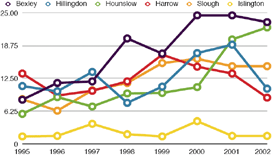 Of the 31 Greater London PCTs, Bexley has had the highest rate of birth defects for each of the five years 1998 - 2002 a new report has shown.
The rate of babies recorded [by the Office of National Stastitics] as born with defects in Bexley during 2002 was between 15 and 59 times greater than Islington.
CMO informs all UK doctors of worrying increase in gastroscisis
Sir Liam Donaldson has informed all UK doctors on page 3 of Chief Medical Officer's Report to Doctors [Winter 2005, Issue 43] of:
"a worring increase in the prevalence of gastroschisis, serious congenital anomaly in which part of the abdominal wall is missing, allowing intestines and other organs to protrude. The number of cases has almost trebled in the last 10 years..."
Sir Liam added: "The cause is unkown.........." and called for "more research into the underlying causes and the reasons behind the recent increase in cases".
The ONS reported 132 cases of gastroschisis in England & Wales during 2003, out of 624,816 recorded births, ie a rate of 2.1 cases per 10,000 births.
The gastroscisis rates in Wales during recent years are far higher than the 2003 England & Wales rate as can be seen from the Western Mail article of 19 March 2005 which reflects the greater volume of PM2.5s released in Wales, which has already made it the asthma capital of the world and now looks likely to become the birth defect capital as well.
Rural birth defects at least 39 times higher than Central London
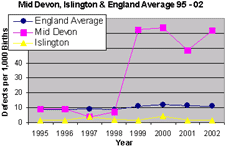
Research has found that one in every sixteen babies born in rural mid Devon in 2002 had at least one defect recorded by the Office of National Statistics [ONS], compared with less than 1 in 630 babies born in London’s Islington during the same year.
Data for every Primary Care Trust in England analysed.
Bexley Birth Defects
Bexley has had the highest rate of birth defects out of the 31 Primary Care Trusts in Greater London for the 5 years 1998 - 2002. The odds of this being a random event are 28,629,151 to 1 against.
See the statement of evidence against the proposed Belvedere incinerator.
Concerns within Parliament and beyond
McMaster University "Reduction of Air Pollution Lowers Risk of Mutations in Mice"
Ontario College of Family Physicians "Pesticides & Birth Defects"
Hansard items
"Incinerators: Weapons of Mass Destruction?"
Sint Niklaas Report
Background to Birth Defect Research
The Thalidomide scandal in the UK prompted government collection of birth defect data "as a means of providing early information of causal factors of congenital malformation". The Chief Medical Officer wrote to every GP in January 1964 to remind them that "following the thalidomide tragedy it was generally felt that there should be a national notification of congenital abnormalities so that any increase in these conditions might be noted as early as possible" ["Scheme to notify malformations" The Times, 6 January 1964]
There has been an increase in exposure to both radioactivity and industrial PM2.5s in the UK, hence the upturn in rates of birth defects since 1995.
The US have reduced industrial emissions of PM2.5s since the USEPA Clean Air Rule and have saved $193 billion just from reduced hospital visits and days off work [Washington Post 27 September 2003]